Las Fallas 2026 in Valencia: dates, figures and what they tell us about 2027
The Fallas 2026 calendar as it was published, the official figures for festival members, visitors and money, with their contradictions in plain sight, and the pattern that lets you plan for 2027 even though the official programme does not exist yet.

Las Fallas 2026 in Valencia ran from 1 to 19 March, with the Crida on 22 February 2026 and the Cremà on the night of the 19th. This page gathers the calendar as it was published, the official figures for the festival and the ones that contradict each other.
It also says what does not exist yet: the official 2027 programme. What does exist is a pattern over three years that has barely moved, and with it you can book your flights and your room without waiting for the Junta Central Fallera's PDF.
When were the Fallas in Valencia in 2026?
The structure was the usual one: warm-up events at the end of February, a daily mascletà from 1 March and the main week from 15 to 19 March. The times in the table are those published by Visit Valencia, OkDiario and Hello Valencia in February and March 2026.
| Event | Date in 2026 | Time | Where |
|---|---|---|---|
| Crida | 22 February 2026 | at nightfall | Torres de Serranos |
| Cabalgata del Ninot | 28 February 2026 | afternoon | centre |
| Daily mascletà | From 1 to 19 March | 2pm | Plaza del Ayuntamiento |
| Children's plantà | 15 March, around 9:00 | all over the city | |
| Main plantà | 16 March, around 8:00 | all over the city | |
| Ofrenda | 17 and 18 March, from 15:30 | Plaza de la Virgen | |
| Nit del Foc | 18 March at 23:59 | old Turia riverbed | |
| Cabalgata del Fuego | 19 March at 19:30 | centre | |
| Children's Cremà | 19 March | 8pm | all over the city |
| Main Cremà | 19 March | 10pm | all over the city |
Two caveats. Visit Valencia gives 22:00 for the big fallas, except the first prize winner in the Sección Especial and the city council's own falla, which burn later; OkDiario prefers a window of 20:00 to 23:00. And elDiario.es ran a headline saying the Fallas "start on 15 March", which is the main week, not the full cycle.

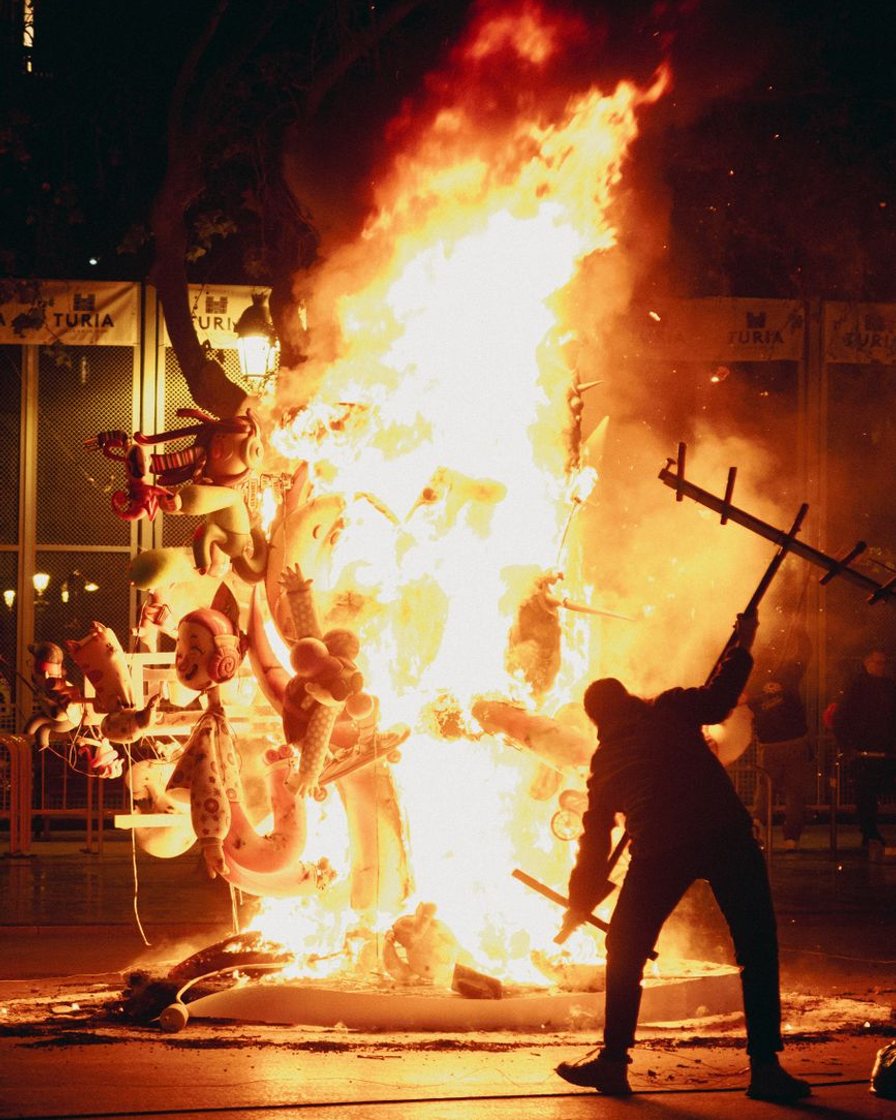
Photo: Maria19731008, CC BY-SA 4.0, via Wikimedia Commons
What do we already know about the Fallas 2027?
Nothing official. The Junta Central Fallera published the 2026 programme in December 2025, and there is no reason to expect the 2027 one before the autumn. Any 2027 date you see on a blog today is a projection, ours included.
The projection is solid, though. The 2024, 2025 and 2026 editions all kept mascletàs from 1 to 19 March and the Cremà on the 19th, Saint Joseph's Day, which is fixed. The only recent exception was the 2024 Crida, postponed to 3 March 2024 because of the Campanar fire.
The practical consequence is that the nights of 17 to 19 March can be booked now. A three-star hotel costing €60 to €100 in low season rises to €250 to €500 on those three nights, on the 2026 ranges, and the cheap rooms go first.
The nights of 17 to 19 March are the ones that sell out: the Ofrenda, the Nit del Foc and the Cremà all fall then. A three-star hotel went from €60 to €100 in low season to €250 to €500 on those nights in 2026. See what is left for the 2027 main week before the programme comes out.
See hotels from 17 to 20 March →Affiliate link: booking through it supports the site at no extra cost to you.How many people go to the Fallas?
Five figures circulate and none of them measures the same thing. We give them all, with their year and their author, because choosing one would mean inventing a precision the sources do not have.
| Figure | What it measures | Year | Who |
|---|---|---|---|
| About 800,000 | visitors | 2024 | Valencia City Council |
| 931,639 | visitors, mobile phone data | 2019 | Telefónica, via Levante-EMV |
| 1.3 million | people present, residents included | 2023 | Universitat de València |
| 946,400 | people present on a single day, the 16th | 2026 report | LUCA Tourism for the city council |
| 40.7% | share of residents among those attending | 2025 | UV and Ivie study, via Business Insider |
The LUCA report also gives 933,100 people present on the 15th and 908,700 on the 17th, but the available extract does not say which year they refer to. The council's 2026 review spoke of "record figures" without publishing a visitor total: that figure, for 2026, does not exist.
How much money do the Fallas generate?
Here the contradiction is bigger and documented. The Universitat de València's technical report for the city council (DT09, on 2023) put sales at €500.5 million, with €125.5 million of income and 4,525 jobs.
The same council's communication in 2024 gave €733 million in sales, €177 million of income and about 6,500 jobs. El Mundo published €732.6 million from the same material. That is a €230 million difference for the same thing, with no note explaining the change in scope.
For 2026, Valencia Extra reported an estimate of €1.1 billion in economic return, with no breakdown. The jump from 500 million to 1.1 billion in three years says more about the methods than about the festival.
Falleros, committees and monuments, in two versions
The fallero census is the cleanest series: 103,317 falleros in 2023, 126,819 in 2025 and 128,675 in 2026, according to the Junta Central Fallera and the city council. That is 25% growth in three years.
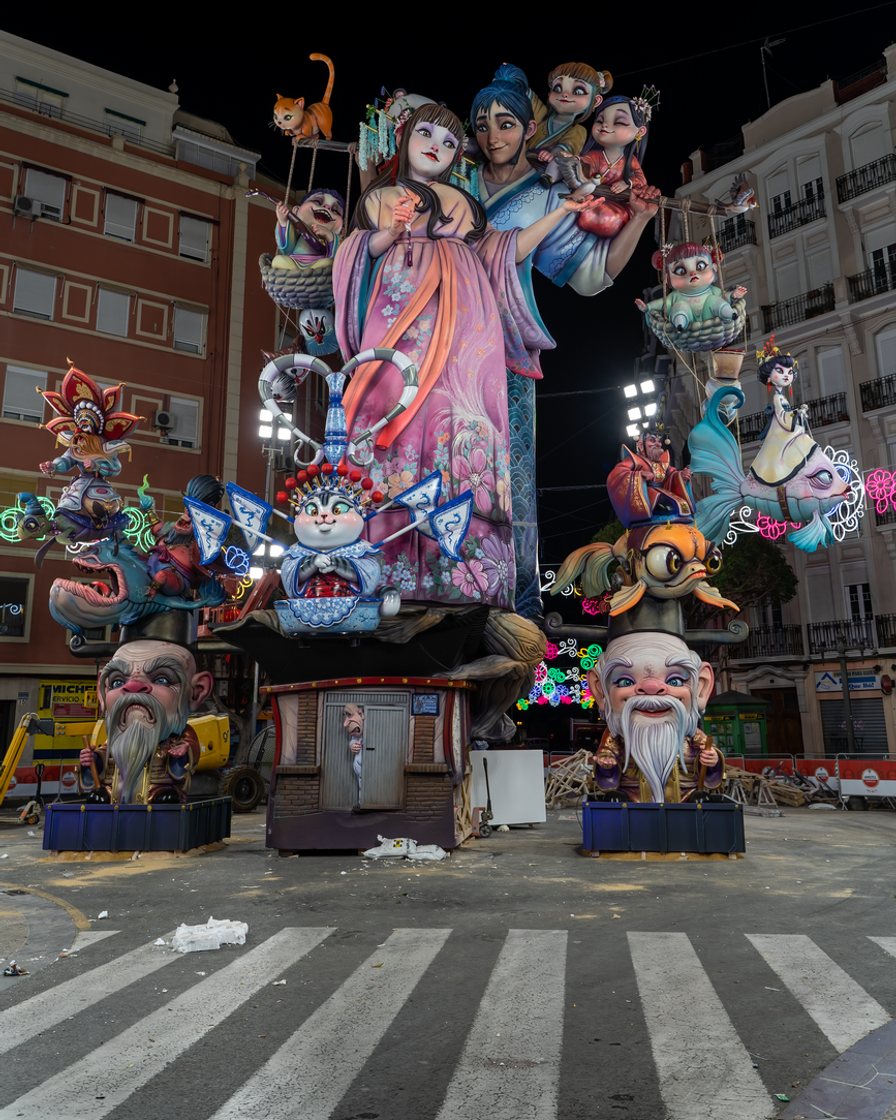
But the 2025 economic study quoted by Business Insider speaks of nearly 90,000 falleros and 348 committees. The council speaks of nearly 350 committees and around 700 monuments in 2024; elDiario.es counted around 750 main and children's fallas in 2026.
The committees match. The falleros do not, and the gap (some 37,000 people) is too large to be rounding. The reasonable hypothesis is that one figure counts registered members and the other active ones, but no source says so.
What is free and what do you pay for?
Everything that happens in the street is free: mascletàs, fireworks, the Ofrenda, the parades and the Cremà. The money is made around the festival, and nobody publishes those prices in a table.
- Ninot Exhibition: €3 full price and €1.50 reduced in 2024. In 2026 it had 99,261 visitors.
- Sección Especial pass: €15 per adult and €12 for ages 4 to 12 in 2024, to go inside the barriers of 9 fallas.
- Balconies for the mascletà: from €70 to over €150 per person in 2026, according to the guides; there is no official rate.
- Hospitality: Distrito Fallas estimates about €542 million of spending, close to 73% of the total.
The studies agree that most of the money goes to hotels and restaurants, and no office publishes a price range for the main week. What you can compare are the prices of organised activities, which have a stable catalogue in Valencia.
You cannot buy the mascletàs or the Cremà, but you can buy a guided tour of the workshops or a fallas route: they are among the few parts of the festival with a published price and free cancellation. Compare the catalogue of activities in Valencia before booking a €150 balcony.
See activities in Valencia →Affiliate link: booking through it supports the site at no extra cost to you.
The plan for beating the crowds
Plaza del Ayuntamiento fills up from 13:30 on mascletà days. The most cautious guides say to arrive 60 to 90 minutes early at weekends; the optimistic ones, 30 to 45 minutes. The show itself lasts 5 to 7 minutes.
The alternative general guides leave out: the neighbourhood mascletàs (Ruzafa, Patraix, El Carmen, El Marítim) let you see several in a row without barriers. And from 1 to 10 March the mascletà fills the square but you can still move around.
For getting around, the metro closes central stations from roughly 12:30 to 14:30 and private traffic is banned from around 15:00 on 16 March to around 4:00 on 20 March. We cover it in our guide to getting around Valencia by metro, bus and tram, and for anyone with a hire car, in parking in Valencia during the Fallas.
If you want each event explained one by one, see what happens on each day of the Fallas; if you only need the dates, when the Fallas in Valencia take place. To choose a neighbourhood to stay in, the comparison in where to stay in Valencia has prices by area.
Three gaps in the 2026 figures
Three gaps, so that nobody fills them in for you. The total number of visitors in 2026: the council's review gave the census and the Ninot visitor numbers, not the overall figure. The prices of stands and balconies: they exist, they are sold, and no official source records them.
And hourly crowd curves: the LUCA report gives daily totals, the rest is advice. When someone tells you how many people were in the square at 14:00 on 18 March, ask them where they got it from.
Sources
Junta Central Fallera, Official Programme of the Fallas 2026 (PDF published in December 2025). Visit Valencia, Fallas pages and 2026 programme. OkDiario, 26 February 2026, and Hello Valencia, 3 March 2026, for the calendar. ABC, 2024, for the postponed Crida.
Valencia City Council: 2026 fallero census, 2024 economic impact note and technical report DT09 by the Universitat de València on 2023. El Mundo, 2024. Business Insider, 2025, on the UV and Ivie study. Levante-EMV, 2023, for Telefónica's mobile phone data. LUCA Tourism report for the city council, 2026. Valencia Extra, March 2026, for the festival review.
Distrito Fallas for hospitality spending. Las Provincias and Valencia Bonita, 2024, for the Ninot and the Sección Especial pass.
Frequently asked questions
When are the Fallas in Valencia in 2027?
Are the Fallas in Valencia free?
How many falleros are there in Valencia?
How many people visit the Fallas?
Neus Ferrer
Neus has belonged to a falla commission since the age of eight and has seen twenty monuments go up. She knows which streets are closed from the day before and at what time the mascletà can no longer be heard from the centre. She does not recommend a spot where she has not stood for hours.